Eight Interesting Facts about the Colosseum


The Colosseum (Coliseum) is one of the great Roman’s architectures that survive for 2,000 years, even after several natural disaster attacks. It becomes a monument of inhuman games tradition for people’s satisfaction, but as well as a monument of how impressive the Roman engineering was. After my recent visit to Rome (Italy) last week, I noted there were eight interesting facts about the Colosseum.
1. Flavian amphitheater was the initial name of the Colosseum.
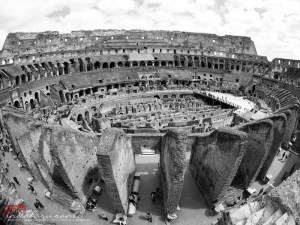 2. It took ten years to finish the amphitheater, using slaves as manpower. It was initiated by Emperor Vespasian in AD 70 but his son and successor, Titus who finished the amphitheater. Titus opened the amphitheater by holding 100 days of games.
3. The Colosseum was estimated to be able to hold up to 80,000 spectacors.
4. There were four levels of seating. The first level called as the Podium, and for important Romans like the priests, the government officials and senators. The second level called as Maenianum Primum and for important Romans as well but non senatorial like the knights. The third level aimed for regular Roman people – usually called as the plebeians, and divided into the wealthy and the poor. The fourth level aimed for women. Slaves and ex gladiators were not allowed to enter Colosseum.
5. Gladiators who played in Colosseum were generally wars prisoners, criminals condemned to death but later due to popularity of the games, the free men also participated in the games and they were called as auctorati.
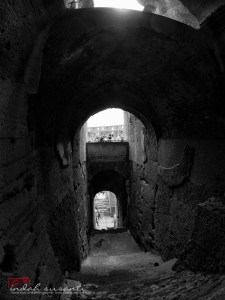 6. There were several type of games played in Colosseum, and that includes the naval battle and wild animals hunts. The games in Colosseum aimed to distract the working class and the elites from important political issue and changes in the Roman Empire.
If you are curious about the naval battle picture looked like, please check this blog post.
7. Wild animal hunts usually started at the beginning of the spectacle. The wild animals were varied from giraffe, lions, crocodiles and even dogs. They were captured in Africa and Mediterranean regions. According to some articles, during the 100 days of games by Titus, the Romans used 9,000 wild animals. Additionally, during Julius Caesar’s ruling, when the Romans did not have enough meat to fed the wild animals, Julius Caesar gave order to threw the inmates to the starving wild animals. Some inmates preferred to commit suicide rather than being eaten alive by the wild animals.
8. The Colosseum has survived from fires and natural disasters included earthquakes. In year 2012, the Colosseum was slanting lower on one side down to 40 cm. An Italian shoe billionaire, Diego Della Valle, put 25 millions Euro to restore and save the Colosseum. After all, there was a popular quote by Venerable Bede: “While the Coliseum stands, Rome shall stand; when the Coliseum falls, Rome shall fall; when Rome falls, the world shall fall.” Keep the Colosseum stands still, and the world shall not fall.
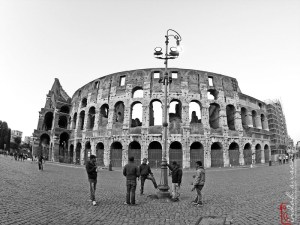
Group of “selfie stick” sellers in front of Colosseum
Tips when visiting Colosseum
Colosseum is a very popular monument in Rome with (roughly) 10,000 visitors per day. It is advised to buy the ticket online and bring the printed ticket to avoid long queue. The Colosseum ticket also include an entrance to the Roman Forum.
It took me less than 15 minutes to enter Colosseum with printed online tickets.

 indahs: dive, travel & photography
Been there, saw that. Very impressive site. Check it out at night. Jim
You are right, the night view of Colosseum is impressive! I will post the image later on night walking around Rome post 🙂 Thank you so much Jim for dropping by 🙂
Baca fakta 6 & 7 bikin ngeri Mba,kok agak kejam ya rajanya..
Iya, aku kebetulan ke sana bareng sama ibu dan ibu-ku denger sejarahnya merinding dan gak mau lama-lama di dalam Colosseum 🙂
Mungkin kalau malem-malem kesana feelnya dapet ya Mba hii
Beautiful pictures and lovely writing! A place full of history, worth visiting.Have a great day! 🙂
Thank you so much Lucy! It is one of amazing places in the world with special history 🙂
What great shots!
Thank you so much 🙂
It keeps you awe stuck. The Colosseum (greatest Roman’s architectures), it has stood the test of times and so many stories have just unfolded in front of the gallery. There was entertainment, there was barbaric scenes, there were spectators across the spectrum of society and it was demarcated in the podium. Ten years to set the massive structure in place…80,000 spectators in those days is not a small number to witness such events.
Very informative post and like the black and white pictures which you have so nicely taken and giving a nostalgic touch to the place.
Tips well suggested…will pass on.
😀
Thank you so much Nihar! You describe it very well. There was a feeling of nostalgic when visiting the Colosseum. It made me wander what was it liked before. I am not sure I would enjoy the past of the Colosseum even if I were living on that era, it was too barbaric…but nowadays we can always enjoy it as a historical monument, a great landmark 🙂
Yes, you are right sometime history is such a mystical aspect to look at, you don’t know should you appreciate or express your empathy for many places where things have happened against the basic principles of humanity. The work is appreciable but the actions painful to recollect.
Every historical monument has something extreme of good and bad…
😀
Great picture. Maximus Decimus Meridius fought here 😛 Fish eye lens are a magic sometimes 🙂
Thank you! Great movie it is 🙂 Yes, that lens is especially perfect for any round stuff 😀 😀
Beautiful, Indah! Love, Amy ❤
Thank you so much Amy 🙂
Indah!!!! Just last week for you to Rome & The Colosseum!!!! We were there September 2014!!! Good job reporting the details on it! We were amazed how many other colosseums the Romans built that we saw in Verona, Italy, & in Nimes, France! Phil
Impressive building, isn’t it? Thank you so much Phil! I wish I could visit the rest of Roman colosseums in other part of Italy. And enjoying great pasta of course 🙂