Majestic Manta Rays – Facts, Threats, Images & Video
In this fourth edition of Marine Life monthly post, I am honored to include beautiful photos of Manta Rays from talented underwater photographers: Andre Philip, Boris Bialek and Chuck Gerlovich. Special thanks to Andre, Boris and Chuck for allowing me to use their amazing photos in this post.


My diving certifications include a specialty of Manta Ray Diver – thanks to Scuba Schools International (SSI) and Orca Dive Center in Flores (Indonesia) for this exciting and eye-opening course. That’s my one of my favorite achievements in scuba diving after getting my first article and photography published in a diving magazine. My first encounter with Manta Rays was in Nusa Penida, Bali where I was at 15-meter depth and watched seven manta rays did the manta’s “circle” on the surface. It was a beautiful sight. The second encounter was in Komodo, Flores where I had a chance to dive for 70 minutes with more than ten Manta Rays!
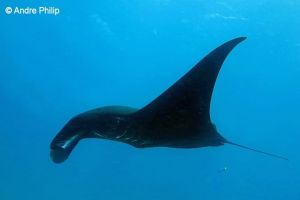
Black Manta in Raja Ampat by Andre Philip
Up until today, there are two species of manta rays identified: Giant Oceanic Manta Ray and Reef Manta Ray. Both species are migratory animals, endangered and protected by International Convention on Migratory Species of Wild Animals. The Reef Manta Ray has a maximum width of 4.5 meters with a weight of around 1,5 tonnes.
Meanwhile, the Oceanic Manta Ray has a width up to 7 meters with weight up to 2 tonnes. Other difference of the Oceanic Manta and the Reef Manta can also be seen from their dorsal patterns on their shoulders. The Reef Manta has Y-shaped on the shoulder stripe while the Oceanic has T-shaped shoulder stripe.
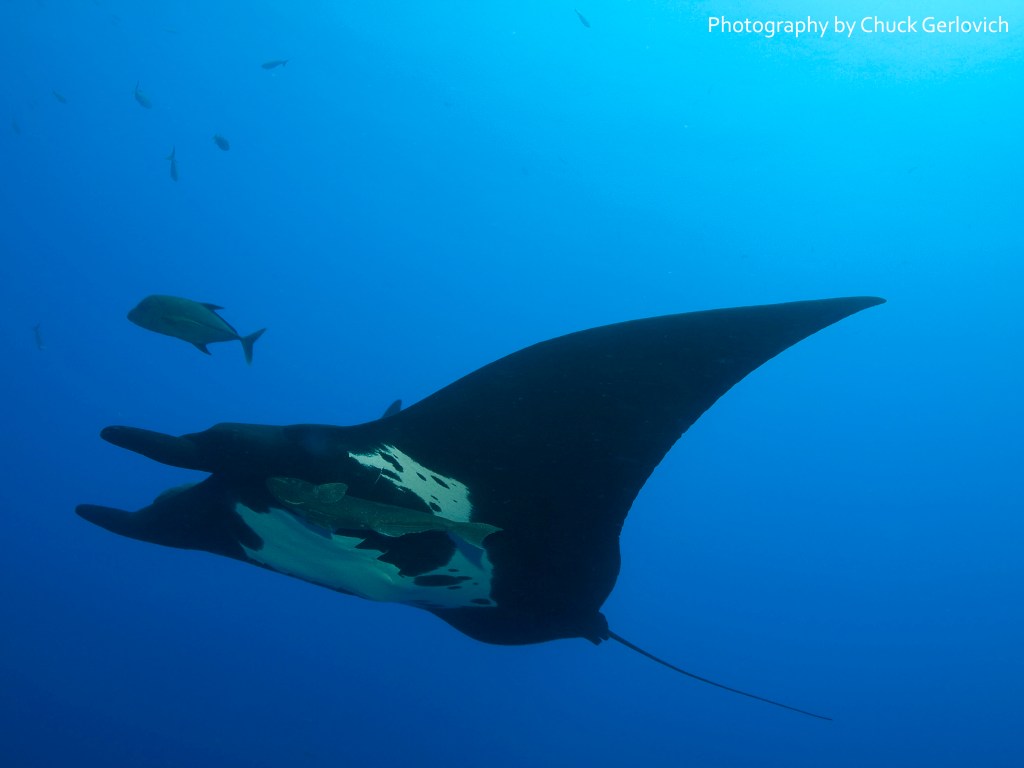
Interestingly, every manta ray has its patterns/spots on its belly, and these spots can be used to identify them individually. Manta’s spots are similar to human’s fingerprints. When I took the specialty course, I had to identify the mantas through their spots on their belly. It was fascinating to see how unique the manta ray from each other. This identification method was introduced in IDtheManta Initiative from a nonprofit organization Manta Trust to monitor the number of Manta Rays population. Scuba divers and snorkelers are welcomed to send their manta photos to Manta Trust to help their monitoring program.
The Manta Ray does not have dangerous venom like the sting ray. Its tail also does not contain a spine. In fact manta rays are gentle swimmers and they portray no threats to human, but sadly they are facing threats that lead to extinctions.
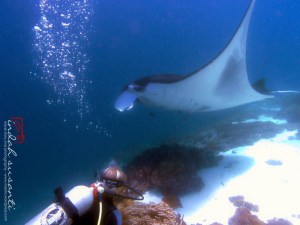
Just Look, Don’t Touch!
Manta is a slow swimmer that makes manta an easy target by irresponsible hunters who look for its meat for sale and the manta’s gill raker (Peng Yu Sai in Chinese) for Chinese traditional medicine. Peng Yu Sai is believed can reduce the toxin in the blood and cure cancer. Despite the fact that it has been proven not helpful to cure any health problems, the illegal manta hunting is still ongoing. It will never stop unless the demands for Peng Yu Sai and the Rays meat discontinued. That will be a huge achievement if these people stop consuming endangered animals.
Another threat to the Manta Rays comes from their own admirers, the snorkelers and scuba divers, who would like to touch them. The human touch to the Manta caused the Manta Ray loses its protective mucous layer on its skins leading to infections to the Manta Ray. The infections could cause long term pains to the Manta. Please, if you are snorkeling or scuba diving for the Manta Rays, do not touch Manta Ray because your touch will harm the Manta Ray.
I am glad that my country, Indonesia, takes the issue of endangered manta rays situation seriously. Earlier this year, the Indonesian government announced the world’s largest sanctuary for manta rays within the country’s exclusive economic zone (EEZ) that covers 6 million square kilometers! No manta rays fishing and selling allowed in Indonesia. The authorities have arrested illegal manta rays traffickers since the sanctuary applied. I hope this effort will continue and stimulate other countries to protect the Manta Rays within their water zone from the greedy hunters and traffickers!
The Mantas usually can be found in the shallow tropical and subtropical waters and around remote islands. They look for an area that full of plankton so the visibility of the water usually not clear just like in this following video. The video was taken in Komodo when I was diving with them.
The Reef Manta Rays especially the females are social towards scuba divers and snorkelers. They are very gentle swimmers though so just ensure while observing them that you do not touch any parts of the Manta Rays. The Oceanic Manta usually found in cooler waters, although it was reported the sights of Oceanic Manta in warm waters of Raja Ampat (Indonesia).
Here is the list of places where the Manta Rays were seen as I gathered from some scuba divers reports and reviews.
- Australia – Byron Bay, Lady Elliot, Ningaloo Reef
- Costa Rica – Cano, Cocos
- Ecuador – Galápagos Islands
- Hawaii – Kona Mantas
- India – Andaman Islands
- Indonesia – Nusa Penida, Derawan, Komodo, Raja Ampat
- Maldives
- Mexico – Cabo Pulmo, Revillagigedo Islands
- Mozambique – Tofo
- Micronesia – Palau, Yap
- Thailand – the Similan Islands
November 24, 2014, Update from Readers where the Manta Rays have been seen:
Australia – Heron Island
Indonesia – Sangalaki Island
Sudan
Tanzania
2015 Update from Readers where the Manta Rays have been seen:
Ecuador – Isla de la Plata
Japan – Ishigaki Island
Bora-bora Island
Have you seen Manta Rays? Or do you wish to see them someday?
 indahs: dive, travel & photography
I loooooove it!! Another amazing story Indah!!
I love Mantas and have seen one in the Maldives, though I wish I had spent more time with the one I saw and to have seen more of them. I didnt know they didnt cause any harm to us humans, and specially that we caused harm to them… its really good to know that!! How cool that you made a specialty course, Im very interested on courses like that 😀
But guess what? I finally decided where me and W are going in May… and we will be going to your country for 2 weeks!! We are staying 1 week in the Gili Islands and 1 in Lembongan…. so I most probably will see some Mantas there!! Im very happy we our decision and really excited to plan everything 😀
Ps: the pictures are amazing, I will make sure to check out the photographers’ website 😀
Thank you so much Allane! The course is actually part of being an Advance. SSI tries to provide specialty courses that matched to the local area specialty so in Flores, it has special local specialties courses: drifting course and manta ray diver course. Additionally, the Orca Dive Center in Flores also provides a special course about Manta Identification and Research together with Manta Trust as special occasion. I am not sure if they are still doing the course but if I were in indonesia, I am sure I am going to participate in such occasional course as well 😉
It is such a great program!! I love that… in Egypt depending on the season they have a Dugong specialty course.
I would love to learn more about Mantas and other marine animals, especially whales and sharks!
maybe just take another degree in marine biology 😀 just check around – I think there must be some short courses related to that 😉
hahaha that would be awesome! I admire the marine biologists, they know so much, they can recognize basically everything underwater!! And their office is often the best 😀
Stunning! It must’ve been an experience to remember. 🙂
Thank you! It has 😉 Have a great weekend!!
A very interesting and informative post, Indah. The photos by your friends are great too.
Thank you so much Draco! They are very talented UW photographers!
I wish I could at least finish my OWD certification!! These are super gorgeous pictures. Love it.
Please do 😉 These animals are really lovely to see underwater…but you can see them when snorkeling too 😉
I wish I was good with the element known as water 😀
I need to improve my swimming first 😀
😀 😉 Yup, that part is important but you don’t have to worry, no need to be a very good swimmer to be a scuba diver 🙂 Have a great weekend!!
I have done the pool sessions. Couldn’t do the sea diving.
You too have a great weekend ahead 🙂
Reblogged this on IdealisticRebel's Daily View of Favorites.
Such beautiful and magnificent creatures these are! Nice to know that Indonesian Government has taken initiative to preserve these endangered species… 🙂 The photos are spectacular, as they always are 🙂
Thank you so much Maniparna 🙂 Best wishes and have a great weekend!
You are so lucky to see them in their world. They are so beautiful and delicate. I have never heard that touching them can harm, but it probably goes for any creature: we are supposed only to observe them in awe.
That’s true, it is better to just observe them 🙂 Many thanks Inese! 🙂