Nine Endangered Marine Species
10th edition of Marine Life monthly post. Marine Life post is published every 19th of the month. It aims to share information on specific marine life species and to promote their conservation. All images are taken by Indah Susanti unless stated otherwise.
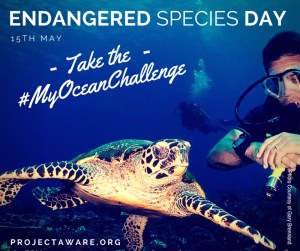
Ocean Challenge by Project Aware
Endangered Species Day was celebrated every year on the third Friday in May. The day was intended to promote the importance to protect the endangered species to keep the nature in balance. According to Marinebio.org, the numbers of endangered species from marine life are on the rise. The threats to them are difficult to recognize as they are not as visible as the animals on the land. However, they do have similar vulnerability and even more vulnerable than the wild animals on the earth.
I have been dreaming to see some of the endangered marine species during my dives, but they were not easily to spot on. Let me introduce nine endangered species that I have seen or I wish to see. I do hope they will last for many more years.
Bluefin Tuna fish
Maybe I should stop wishing to see schools of bluefin tuna during my dives. Bluefin tuna meat is popular fish meat, and due to its popularity, the fish became a popular fishing target in the last 30 years. We, humans, managed to reduce bluefin tuna population over 90 percent during that period and had caused the Atlantic bluefin tuna vanished from the ocean. Further information and pictures of bluefin tuna, please visit The Tale of the Bluefin Tuna.
Corals – Staghorn
IUCN Red List, an international organization deals with the conservation status of species, noted that several species of staghorn corals (Acropora) have been reducing exceeding 80 percent over the past 30 years and classified as critically endangered. The decreasing, number of these corals due to climate change and human-related factors. It is going to be a big issue for our ocean if we lost these corals completely as they are contributing to reef growth, providing habitat and food source for other marine species.


Florida Manatee
I hope someday I will visit the United States to swim with the manatee before they vanish from our ocean. The manatee also called as a sea cow and has a characteristic of being slow swimmer mammal on shallow waters. Its number is declining due to hunting practices for their oil and bones. More information on the manatee, please visit Defenders of the Wildlife.
Grouper
The numbers of groupers in the Caribbean are decreasing. While its vulnerable existence is still on the debate, the fact is groupers are slow breeder species. They might be unable to catch up with human’s increasing needs for fish meat, fishing hobbyist and as well the damaging coral reef after the climate change. When I was diving in Belize and Cuba, I had a chance to dive with Nassau grouper which is classified as endangered species in the Caribbean. Most groupers are solitary and territorial fish. However, Nassau grouper usually more ‘friendly’ to human that makes them an easy target for spearfishing. Goliath grouper is the second favorite target after the Nassau. It’s estimated that the population of groupers has declined by 80 percent in just 40 years.


Hammerhead Sharks
Diving with the hammerheads is our dream dive, and I guess I have to fulfill this dream sooner! Hammerhead sharks are harmless to humans; from nine species of hammerhead sharks, only three species that considered dangerous to humans. The species of hammerhead sharks such as the Great Hammerhead and Scalloped hammerhead are endangered. Meanwhile the rest of the hammerhead species numbers are decreasing and classified as vulnerable by IUCN Red List. Last year, Indonesians were shocked by the sales of hammerhead pups in a chained supermarket. Thanks to social media like Twitter and Instagram, this issue made into public nationally and internationally that demanded the withdrawal of the hammerheads from the market and banned the endangered/vulnerable marine species for sale. The meat was taken away from the market. However, there was no clear sanction against the distributors.


Sea Otters
This image was taken by Girl Gone Expat in Alaska. Lucky her to see the Sea Otters in its protected natural habitat! The Sea Otters were used to be hunted for their fur and meat that caused a serious declining number of its population. The Sea Otters are now enjoying full protection in Canada and the United States. More story of Girl Gone Expat on the Sea Otters, please visit her wonderful post: Playful Sea Otters.

Sea Turtle
WWF stated that nearly all species of sea turtles were in the endangered status. They were killed for their meats, shells, and eggs. I have been diving with them in Indonesia and the Philippines. Sea turtles are the most relax marine species I have ever seen. It has been chosen to represent an environmental cause conserving the marine ecosystem because the turtle is one of the longest living animals on earth that outlived the Dinosaurs!


Sea Cucumber
Sea Cucumber is a popular dish for Asians, but it is only recently the dish with sea cucumber meat gains popularity in Indonesia. If you wonder why these species play a role for the healthy ocean; according to IUCN Red List, it ingests organic matter, bacteria as well as plant and animal detritus and re-utilizes residual food and feces. Nowadays its population is decreasing. Most species are not under threat status, however, one specific species, Japanese Spiky Sea Cucumber is classified as endangered species. Who knows what will happen to the rest of the sea cucumber species in the next coming years.


Sharks
Shark Project estimates 26-73 million sharks dying because of finning. I have been diving with several shark species like Thresher Sharks, Caribbean Reef Sharks, Nurse Sharks, Black/White Tip Sharks and Epaulette Sharks. These species are categorized by IUCN Red List as vulnerable species with decreasing population. There are shark species such as Borneo shark and Speartooth shark, that considered endangered and likely to vanish from our ocean if the finning keeps ongoing.


The shark finning is sadistic and inhuman practice. Usually, people cut only the fins of the sharks and throw the sharks alive back to the ocean and let them die under the sea. Just imagine if your legs and hands were cut and being left alone dying. That’s how cruel the shark finning practice is.
My apology if my post sounds frustrating. I can not ignore the fact that the ocean and its population are often taken for granted. The truth sucks and if we can do something, we can start doing things as suggested by the National Geographic’s 10 Things You Can Do to Save the Ocean. Let’s keep our planet blue!
 indahs: dive, travel & photography
A shame, be it land or oceans. ..over exploitation, sad, ruthless and yes frustrating.
I agree, sadly the land is also facing environmental degradation 😦
yes
Extinction of species is everywhere. Thanks to humans!
We are just too many compare to the wildlife..
True that.
This is so sad. It seems that we, as humans, always wait until it’s too late to take action to save these wonderful creatures. I know that much work is being done to stem the tide of collection acropora, montipora, and other SPS and LPS from nature. They are actually quite easy to propagate, and therefore there is no need to collect them.
Thank you Rob for the info Rob! I have no ideas.. I do hope that will help the corals survival for the long term!
I used to propagate them quite easily. Clean, moving water with sufficient light is needed, with some manual addition of calcium and magnesium to the water. They will adhere to limestone easily.
I think posts like this one are so important to remind people of what’s been happening for ages and that we’re on the best way to losing something beautiful and an important part of nature.
I’ll check out the National Geographic link, thank you for this post!
Time to return the favor to the nature 🙂
Thanks so much Monika for wonderful commentary.
We should ban shark fin as a menu item in restaurants!
Everybody agrees, apart from Chinese government! 😉
I agree!
I can’t bring myself to add a like to this sad stuff. Reminds me of my dream of the golden toads https://port4u.wordpress.com/2015/05/16/dreams-that-became-digital-art/ .
Beautiful arts you created Sherry! Yes, sadly our earth is suffering too much..
Great post Indahs! It’s such a shame that so many of these sea creatures are one day close to being extinct. I didn’t know the Hammerhead Sharks were endangered. Many species of small fish that are used for caviar are also endangered nowadays, and in many ways this is no different to using whales for meat (Japan) or sharks for their fins (China). I only eat sustainable fish, if I can help it.
Hi Lee, thanks..certainly eating only the sustainable fish is a great action! I have heard about the caviar issue..thats a great point! How did I miss it on this post 🙂 the fish that produce the eggs for caviar is now critically endangered and almost extinct! Crazy how it started because of favorable food!
Thanks for great info!
Hi Andy, thank you! Just found your message on the spam folder 😦 something wrong with the WP…