Five Things About Galápagos

The reason we visited Galapagos is actually someone (read: Dutchie) has been dreaming to scuba dive with the schooling of Hammerhead sharks. Three famous locations in the world to scuba dive with the schooling of Hammerhead sharks are Cocos Island (Costa Rica); Galapagos (Ecuador) and Malpelo Island (Colombia). We chose Galapagos because someone (read: Indah) has been dreaming to see the vampire finch birds, marine iguana, and the Galapagos sea lions. Seemed like a win-win solution. Following are the five things about Galapagos that I would like to share with you…
There are four inhabitant islands in Galapagos
The four inhabitant islands in Galapagos are San Cristobal; Santa Cruz; Isabela and Floreana. Meanwhile, the rest of the islands are uninhabited. Each island has its special unique animals, for instance; Isabela is known for its tiny penguins; Seymour North for its frigate birds and blue-footed boobies; Darwin and Wolf Islands for scuba diving with hammerhead sharks and migration path of whale sharks, whales, eagle rays, turtles and much more migrated marine species.
Interestingly, the vampire finch birds, the giant tortoise, marine iguana, and sea lions are widespread in Galapagos islands and its coastline.

Galapagos has two seasons
The dry and cool season usually called as Garua is from July to December. You can expect perpetual mists around the islands and the weather is colder. The Spaniards called the misty Galapagos islands as ‘Las islas encantadas’ (the enchanted islands). The second season is from January to June, as wet and hot season. You can expect rains during these months. Basically, you can visit Galapagos all year round as the animals are always visible to humans.
Charles Darwin spent five weeks in Galapagos and…
…the giant tortoise meat was his favorite meal. It was reported that he ate the supposed science specimen, the giant tortoise in his ship, during his return sailing to Europe. Charles Darwin loved the tortoise meat too much that he even ate the specimen for his research. Talking about science and the scientist’s appetite…

Charles Darwin’s ship route when in Galapagos
Goat was the first invasive species
The first invasive species in Galapagos was the goat. The goat was introduced by David Porter, an American commander who was based in Galapagos to fight the British whaling fleet. The giant tortoise had to compete with the goat on food since the goats ate almost all vegetation in the Galapagos Islands. The tortoise starved to death and its number was decreasing until the Project Isabella had taken over to remove all goats from the islands.
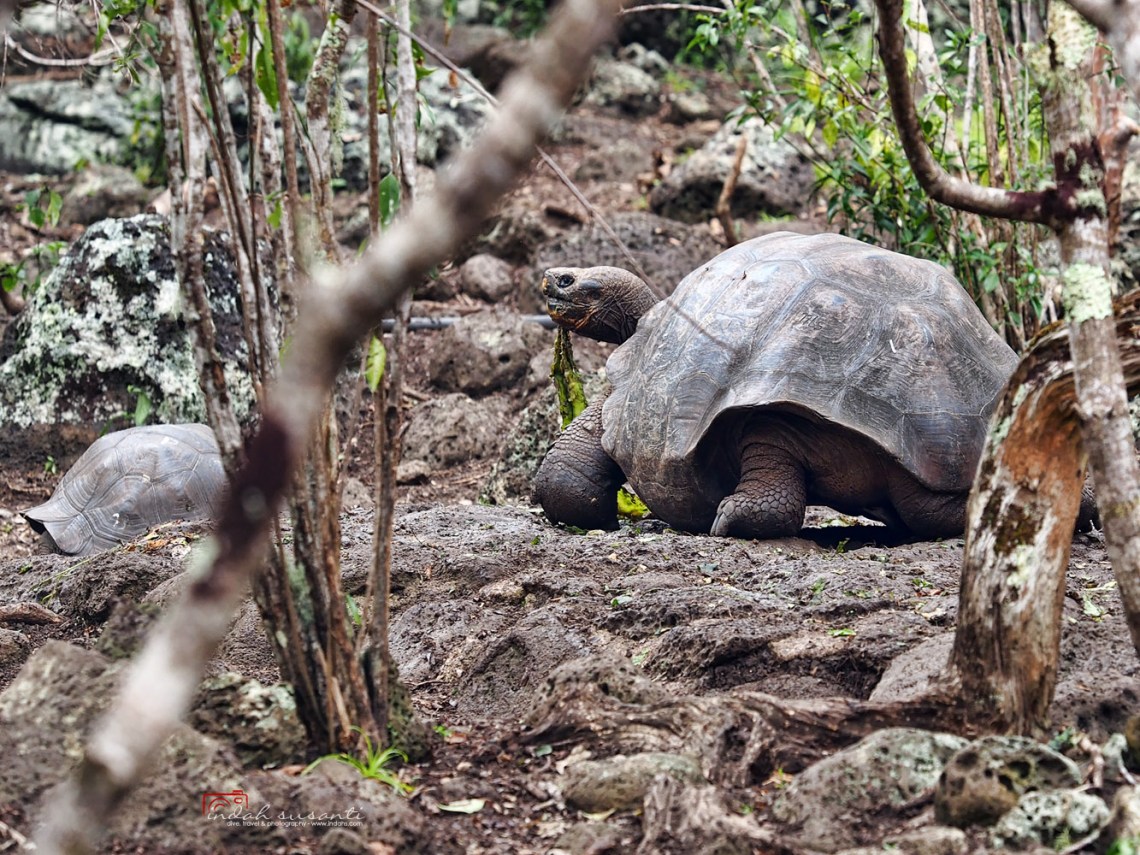
Giant tortoise
Galapagos sea lions were popular in Asia…
…as Viagra. The male sea lions were hunted for their genitals for Asian black market. As an Asian, I had not known this until I read a book about Galapagos and its conservation efforts. Its population was decreasing until they become protected animals and symbol/ icon of Galapagos by the authority. Gosh, these sea lions are so adorable. They do bark when you get too close to them. And their sleeping habits reminds me of my dog – I think they just sleep all day long in any kind of weird positions.


Additional Information…
* When you visited Galapagos from outside of Ecuador, you have to pay a Galapagos Transit Control Document at the airport where you depart to Galapagos (the cost as in December 2017 is $20 per person). Your suitcases and carry-on bags will be checked and locked to ensure that you don’t bring invasive living things (that includes fruits) to the islands. Then upon arrival in Galapagos, you have to pay a fee of the Galapagos National Park (the cost as in December 2017 is $100 per person).
* Drones are not permitted in Galapagos Islands (source) and according to a traveler whom we met during our trip, the tour operators in Galapagos will not allow their guests to operate the drones either.
* Ecuador’s currency is US Dollar. However, pay attention to the coins as some of their coins are actually local.
* Island hopping in Galapagos is an option to save money when visiting Galapagos. There is transportation between the inhabitant islands such as ferry, speedboat, or even chartered planes. From those islands, you can arrange a day tour to the uninhabited islands at the local tourist shops. However, not all uninhabited islands are allowed for tourists. Wolf and Darwin islands are ones of the uninhabited islands in Galapagos that prohibited for tourists to visit. Additionally, only limited boats allowed to be around the islands.
* More informative posts about Galapagos by bloggers, please visit: Andy’s World Journey and Latitude Adjustment
Disclosure: some information in this post also collected from an impressive book written by Carol Ann Bassett: Galapagos at the Crossroads: Pirates, Biologists, Tourists, and Creationists Battle for Darwin’s Cradle of Evolution
 indahs: dive, travel & photography
What a great trip! I love all your research! Did you get in any reading? ;D
Hi Kristin, it was a great trip and yes, your book is a great companion!! Enjoy it so much 🙂 Thank you!!
I’m so glad you did. And I’m honoured you read it amongst all that beauty. I always enjoy your vacation posts and live vicariously through you. I wish there was scuba in Buenos Aires for you!
kura-kura Galapagos .., itu pertama kali dengar nama pulau dari pelajaran Biologi..
dan mbak Indah sudah ke sana.. waw banget
trip impian ini
Samaaaa…denger pertamakali juga dari pelajaran Biologi. Tapi kepengen ke sananya setelah nonton dokumenter ttg Galapagos. Amiin..moga-moga impian kesampaian. Masuk ke Ekuador gak perlu visa buat paspor Indonesia 🙂
A wonderful experience, Indah, and a wonderful sharing.
Thank you for this.
Big hugs
bapak john
Thank you so much, Bapak John! It was a paradise for wildlife lovers 🙂
Another informative post on travels, Indah, and this time to the Galapagos. It is amazing to hear how many different animal species it has. So interesting to hear about competition of food. You’d think there are various food sources, but then there are also others who wouldn’t mind eating your food source if that is the only option all round. It is interesting to hear that drones are not allowed since they are so popular everywehere. Maybe you just never know what can go wrong with drones – they might be quite the distraction to the animals and you don’t know they will react. Great photos again all round, Indah 🙂
Hi Mabel, thank you so much! Galapagos feels like a perfect place to have close encounter with the wildlife. They are just there right in front of you. Sometimes we saw them lying on chairs or in front of hotel’s door step. No one dares to remove them, just let them sleep or sitting there whatever they like. They all are protected and should not harassed. I guess that’s something we can do as humans as we have invaded their space as well 🙂 You are right about the drones, they create distraction to the animals..the drones make very loud sound that can scare the animals away..
Loved these fun facts (Viagra?!?) and your pictures are magnificent as always. As far as barking sea lions, they used to fight over who could sleep on our poop deck when we sailed there in 2013. We were often woken up by the barking in the fight for dominance. Did you manage to swim with any of the lovable little penguins?
Also, there is a place in Fiji off Savusavu where you can swim with hammerheads (or at least one could in 1015). Delays in our trip disallowed us from doing so, but friends of ours did.
The Viagra fact blew my mind too – it’s not even scientific proven! That must be a funny moment to see them barking at each other. I saw them barking at each other on the beach, at first I was freaking out but later I found out that’s how they argued against each other or perhaps that’s how they talked 😀 Unfortunately we did not visit Isla Isabela this time, we just have to return 😀
Thank you for the information about Fiji and hammerhead sharks! I wish someday we managed to go to Fiji, it’s another paradise to scuba dive 🙂
Quel merveilleux billet Indah, les couleurs sont sublimes et tes photos sont de toute beauté 🙂
Mes amitiés
Merci, Denise ❤
Thank you very much for this informative post, I liked the breakdown of the park fees, I had no idea you were using US dollars there… and OMG this story about Darwin and tortoise meat :Z
I find it bit weird that they use foreign currency money but it looks like it work well there. Darwin’s appetite on tortoise meat makes me wonder how delicious the taste of the meat..maybe it’s good thing they are being protected animals 😀
You live an amazingly interesting life and thank you for taking time to share your experiences. I have learned so much from your Blog
Thank you so much, Diana! Gladly sharing my travel experience with you 🙂 Hope it will inspire us to care the planet and its residents 🙂