The Whale Sharks and Oslob’s Controversy
Sixth Edition of Marine Life monthly post. My apology for the delay than its usual date on the 19th. Please join the polling on this post, share your opinion on this controversial issue!
It is very common for some nature lovers, travelers, and scuba divers to dream seeing whale sharks in their natural habitat, the ocean. It is not surprising, the whale shark is the world’s largest fish and one of the celebrities from the marine life world. The whale sharks are not dangerous to humans. It is a shark species (not a whale!) but they are not aggressive and very slow swimmers (5 kmph). However, with an average weight of 20 tons, the shark has a very powerful tail that could cause serious injury if get smashed at!
Their life span is not confirmed. Some suggested that they could live up to 150 years and start to breed at the age of 30 years. This means the whale sharks have to survive staying alive for 30 years before they start reproducing. Sadly, there are still greedy people chasing them for consumption, additionally, some fishing practices have posed a danger to their living survival. There were some reports on how the whale sharks trapped in fishermen’s nets that caused injuries and even death.
Where to see the Whale Sharks
As migratory animals, the whale sharks can be seen in many parts of the world. Whale shark is a solitary animal, but the shark found easily as a group on the area where there are lots of plankton – they eat plankton, small fish, and squid by sucking them.
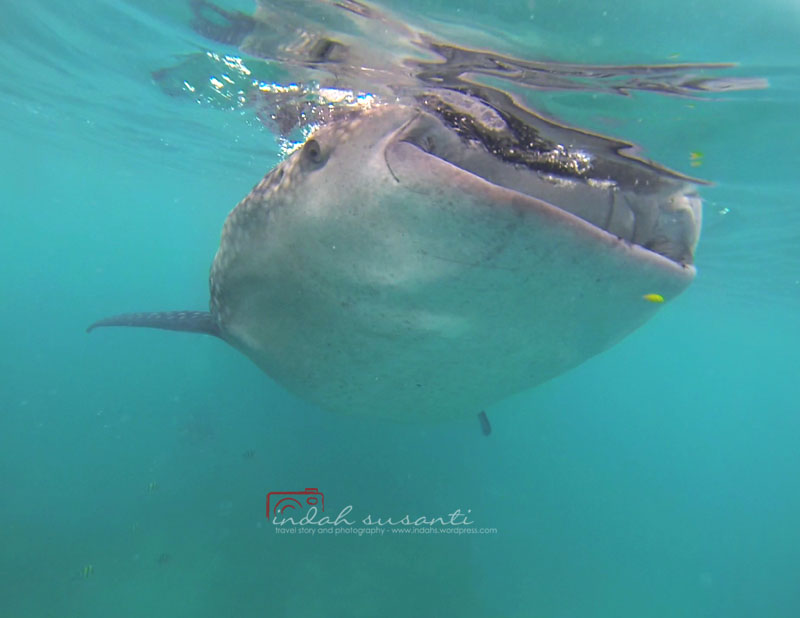
Whale Shark
Lonely Planet has listed places where we can spot them – let me quote the list in short summary (for details, please visit the Lonely Planet’s link):
- Donsol, the Philippines (February to April)
- Gladden Spit, Belize (March to June)
- Isla Holbox, Mexico (June to September)
- Koh Tao, Thailand (April to June)
- Ningaloo Reef, Australia (March – July)
- South Ari Toll, Maldives (May to December)
- South Mahe, Seychelles (October)
- Tofo, Mozambique (October to March)
- Utila, Honduras (March and April)
Additionally, there are places that not mentioned in Lonely Planet’s list but the whale sharks are spotted on these places as well:
- Darwin Island – Galapagos, Ecuador (June to October)
- Honda Bay – Palawan, the Philippines (April to November)
- Isla Mujeres, Mexico (May to September)
- Oslob – Cebu, the Philippines (all year round due to the feeding)
- Mafia Island, Tanzania (October to March)
- Nabire – Cenderawasih Bay National Park, Indonesia (May to October)
Update 27 February 2015
– Las Paz Baja – Mexico
The Whale Sharks (Unnatural) Feeding in Oslob
 The Philippines is a popular country to see the whale sharks. At least, there are three areas where the whale sharks could be seen: Donsol, Palawan, and Oslob. The Philippines government is even featuring the Whale Sharks (butanding in local language) drawing on 100 peso banknotes/bill. The whale shark is an important asset for tourism in the Philippines.
While to see the sharks in Donsol and Palawan is possible on specific months, in Oslob is totally different. The presence of the whale sharks in Oslob is all year round due to the feeding by humans. The fishermen are luring the sharks to water area of depth approx 10 meters near to the shoreline. The fishermen fed sergestid shrimps to the sharks with their hands while paddling a small boat.


All is organized by the locals and supported by the local government. Currently the area is claimed as protected area and no motorboats allowed. It is well organized. The entrance fee includes safety vest, boat trip, and shower. Before going to the boat, we have to follow a briefing about the whale sharks.
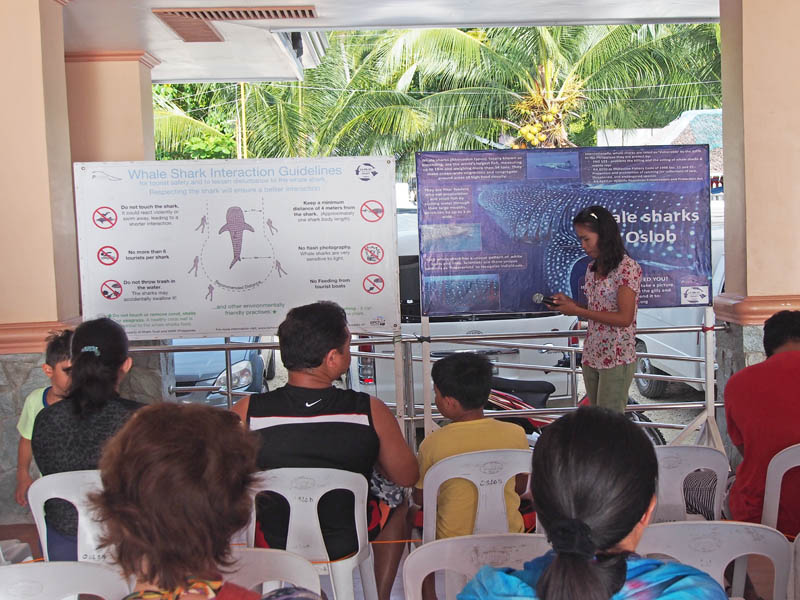
The briefing
The briefing includes some regulations to follow such as:
- Do not touch the whale sharks or harm them otherwise you will risk of prison up to six months and fine
- No camera flash allowed
- No body lotion and sunscreen allowed – if you already used it, then take shower before swimming/snorkeling
- Six people maximum on a boat (with two local guides) and 30 minutes allowed to swim or snorkel with the whale sharks – the guides will let you know
- Always take distance from the whale sharks
The regulations were reasonable. However, the first and the last ones were rather impossible to do in practice. I saw few guys tried to touch the whale sharks. Additionally it was too many people – I think there were around 10 boats with average six people on the boat – so imagine of 40 people (the two guides stayed on the boat) were swimming and snorkeling with huge expectation to see the whale sharks. Not to mention the scuba divers down there. It was too crowded to take distance from the whale sharks. The crowds – as some have feared – could stress the animals.
The Cons of Feedings in Oslob
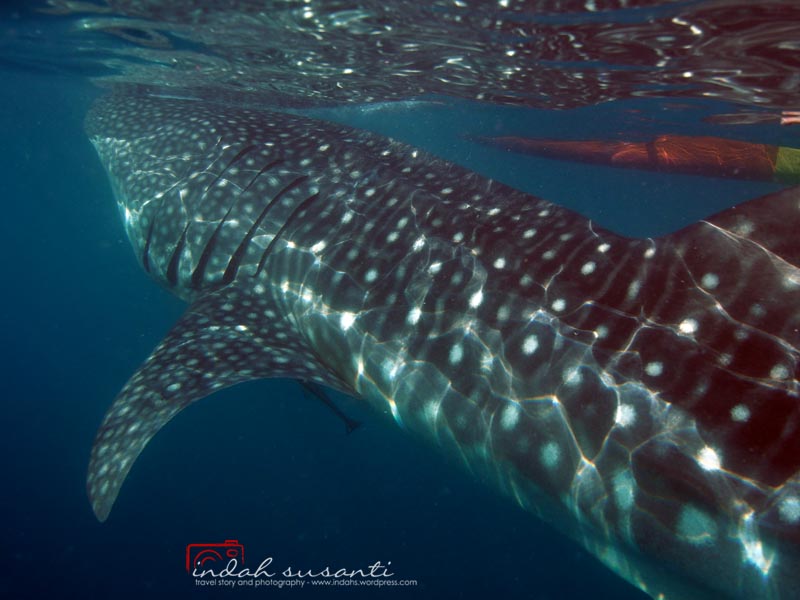
After experiencing it myself, I understand why the environmentalists have concerns on the feeding practice. There are several critics that should be considered for the long-run practice in Oslob.
First concern is the feeding through boats might cause the whale sharks more vulnerable to fishing. It might cause the sharks to keep approaching boats for food. It will be bad news for them if the boats belong to those greedy and irresponsible people. Or other lousy case; they approach the fishermen boats and get entangled inside the fishing nets.
Second concern is, the luring might slowing down the migratory and disturb the reproduction process. It is not natural for the whale sharks to come closer to the shorelines like in Oslob, additionally they are slow swimmers so this critic makes sense to me.
The Pros of Feedings in Oslob
The presence of the whale sharks in Oslob generates good income for the villagers who also fishermen. It will be difficult to stop the practice entirely without providing the villagers alternate income resources. Besides to that, I was told long before the feeding, the whale sharks were already visiting the area to ate the fishermen’s shrimps baits for fishing. The sharks attracted by the shrimps for food. The local fishermen attacked the whale sharks to leave the Oslob waters since that ruined the fishing business. Such practice was far worse than what the fishermen do now.


Another defensive opinion, the practice in Oslob is lesser evil if being compared to longer practices committed by huge organizations like Sea Life and other huge sea-aquariums or zoo around the world that put the wilds in captivity. In Oslob, at least, the whale sharks are free to come and leave.
The Future of Oslob
Before deciding to visit Oslob, I had long discussion with Miia from Pearlspotting who loves whale sharks and had multiple encounters with the sharks. I am thanking her for her point of views and information about the sharks. I had never seen one and I was about to visit Moalboal which was not far from Oslob. It was a dilemma for me. I have been reading about the supports and the condemns before my visit. In the end I decided to go otherwise how can I judge if I have never seen it?
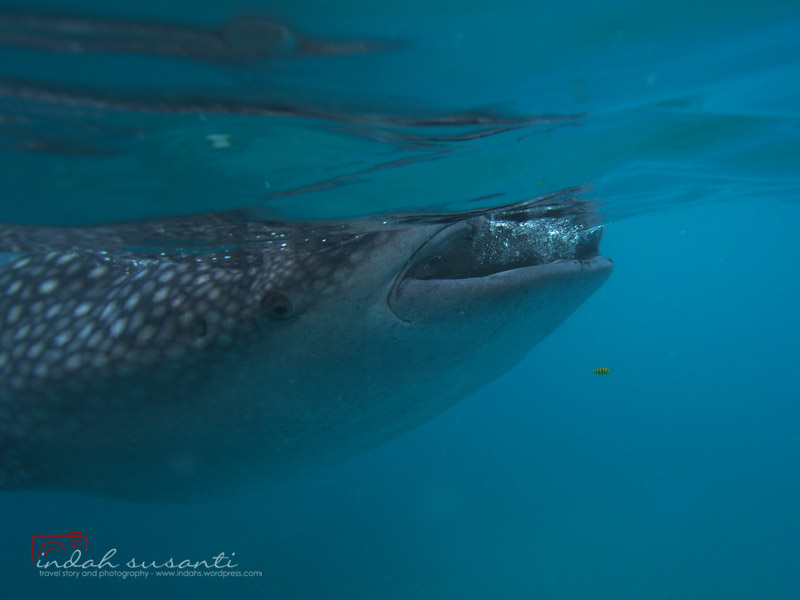
I admitted that I enjoyed seeing the whale sharks in Oslob. However it was with guilt feeling. I love the opportunity seeing the sharks but at the same time I dislike the ideas that the practices might impact negatively to their lives in the wild. I am worried if the critics were correct, we put the sharks in more vulnerable conditions. On the other hand, to discontinue this type of tourism, we will take away the earnings of the locals and maybe the past will repeat that the fishermen have to confront against the sharks for ruining their livelihoods, unless there are sustainable fishing methods introduced to assist the local fishermen.
I have no real solutions for this matter. I guess to stop the practice in the end will depend on the demands and majority public opinion as well. Would you visit Oslob to see the whale sharks? Please let me know via the following polling. I will not judge your choice, and thank you for your vote.
Practical Information
- The whale shark status is vulnerable – close to endanger status as the number of whale sharks keep reducing annually – IUCN Red List
- The location is in Tan-Awan village, Oslob. It can be reached from Cebu (around two hours) or Moalboal (one hour)
- The feeding starts at 8 am until 12 am
- Wear swimming suits upon arrival – the number of changing rooms is limited
- Do not use any body creme/lotion nor sunscreen beforehand
- The cost is 500 pesos for locals and 1000 pesos for foreigners
- Snorkel set is available for rent – I find using fins are helpful to get faster swimming and free diving
For scuba divers:
- Scuba diving costs 3000 pesos (includes equipment)
- Most dive centers in the Philippines are against the feeding practice in Oslob, please do not expect or force the services from certain dive centers to bring you to Oslob
- It is better to snorkel and do bit of free-diving than scuba diving due to shallow waters
 indahs: dive, travel & photography
Firstly, love the close up photos. For that, I would have gone through these experiences over and over just to see them again..haha..when it comes to tourism and animals, I like to give it a try first to really see it through personally but I do try to do research and go for friendlier options if available. The one thing that I’ve always been hesitant about is the deliberate feeding of fishes or animals for tourism purposes. I’ve once gone on a snorkeling trip where bread was thrown to attract fishes in the sea and I felt that this is wrong for the fishes there because that is not their staple diet.
But ultimately, I feel it’s best to go with your own personal feelings. I try to avoid such practices when I travel but it still does occur sometimes. I do prefer to have them in natural setting with no human interference but it also depends on the situation too for me.
Thank you Sha! The experience was amazing – I meant seeing the sharks that close, it’s just rare and different. But yes, it is not easy to see the whale sharks “naturally” – I knew some friends who have been trying to find one for couple diving trips with no luck. I guess at certain point, they may visit Oslob 😦
Wisely said – I agree that it is best to go with how you feel with it 🙂 Have a great weekend!!
Oh, I can just imagine the exciting experience. …at least you have managed to experience it once. Happy weekend to you too! 😄
🙂 🙂
They are amazing! Thanks for sharing with us. 🙂
Thank you so much Sharon! 🙂
Wow, thanks for telling us more about the whale sharks. I answered yes to the poll of whether I would go to see them if I could 🙂 Your photos are stunning!
Thank you so much Christy! Truly appreciate you join the voting 🙂 Have a great weekend!!
Thank you for your explanations and video! Beautiful protect this shark!
Good weekend
Merci!! Totally agree with you Pat – let’s protect the shark! Have a great weekend!!
I think you are right in your instinctive perception, Indah. Whale sharks should not be disturbed. Rather establish an idea bank where some of the people who feed on the industry should be involved. They should help to bid in for other likely livelihoods along with competent environmentalists and interested companies.. Moreover, established some foundations that supported people in the shift to a more eco-friendly work.
Maybe that would change the environment for the whale sharks – maybe not…
Stunning pictures. Must say Pro is doing a good job 🙂 maybe because of you ⭐
Well said Hanna! I am glad we share the same idea! Providing the locals better livelihoods should be an option to stop the sharks with the help from the environmentalists and companies..plus better fishing technologies that will not attract the sharks to come to their fishing area..I just hope there will be such invention..
great discussion we had 🙂 Hope you are having a great weekend!! 🙂
Snow is approaching so maybe there will be an opportunity for a lovely winter motive tomorrow 🙂 Have a great weekend you too, Indah.
Millions of thanks for this interesting and wonderful post!!!! 🙂 Excellent! An amazing video. I love how they “eat”. I will share this on the social media.
Thank you so much Miia! Happy hear to hear that you enjoy the post and the video 🙂 I love that part too 😀 – have a great weekend!!!
Excellent … I truly enjoyed the reading.. Very informative and great photographs as well!
All the best to you dear Indah!, Aquileana 😀
Thank you so much Aquileana! What a coincidence we wrote about “things” from the ocean 🙂 Best wishes for you too and have a great weekend!!
Indah, What a comprehensive narrative on the whale sharks!!!! You sound like the best of zoologists!!! Indah, so very well done! Compliments to you! Phil
Thank you, thank you so much Phil! You are so kind and supportive! Truly appreciate this 🙂 I am honored..wishing a great weekend!!