Crinoids Facts: Feather Stars and Sea Lilies

29th edition of Marine Life monthly post. Marine Life post published every 19th of the month. It aims to share information on marine life species and to promote their conservation. All images and video in this post are taken by Indah Susanti unless stated otherwise.

GIF clip by Natsdorf Tumblr
You might have seen the video of swimming feather star on social media, it was captured by Els van den Eijnden in Padang Bai (Bali, Indonesia) and published in Youtube in November 2016 – Feather Starfish (Crinoid) in Blue Lagoon Padang Bai, Bali by Els Van Den Eijnden. Somehow, the National Geographic on its article in December 2016, claimed the video was made in Thailand, while Dailymail got it right by mentioning the original source, that it was taken in Bali (Indonesia). Sometimes we can not just depend on one news source, can we? 😉
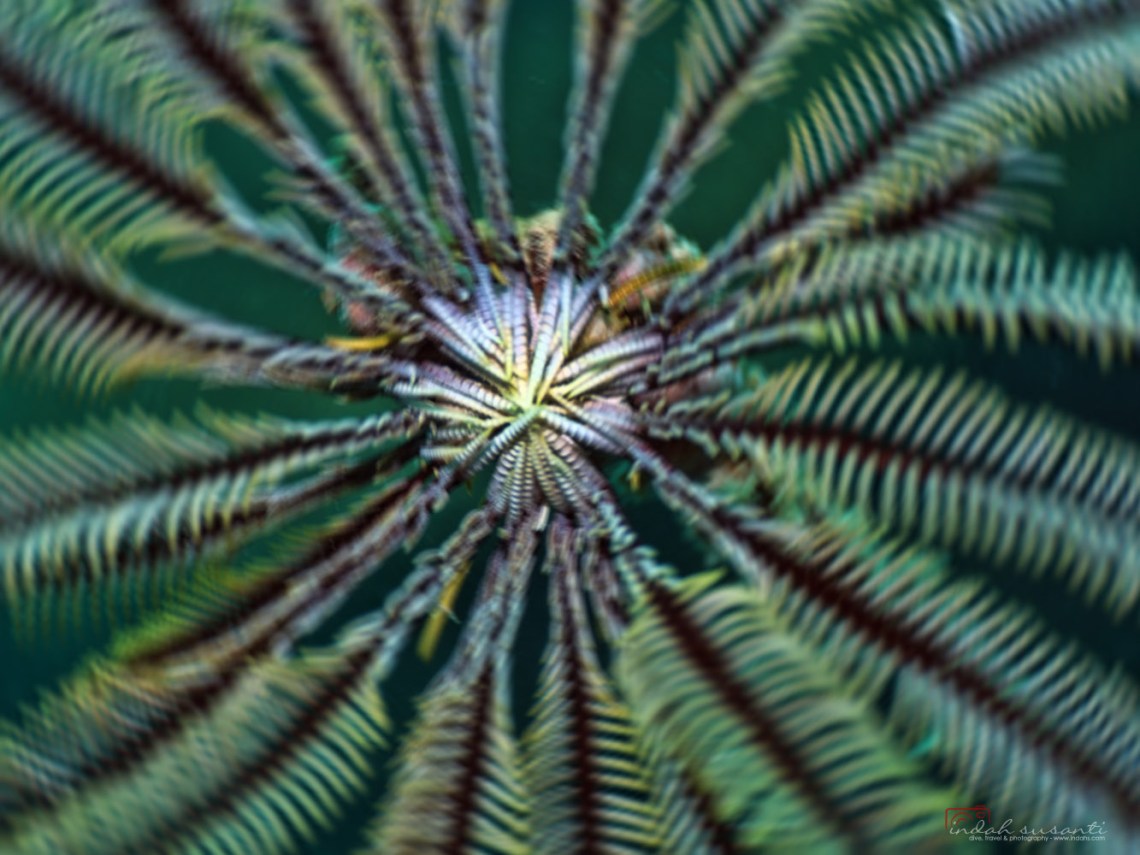
Anyway, the truth that I know for sure: you can see the feather stars in Indonesia and Thailand. This incredible species is actually a marine animal called crinoid. They are common to see in shallow waters and as well in deep waters.
There are two types of crinoid, the crinoid that have stalks called as sea lily; and the ones that have no stalks called as feather star. Instead of having stalks, the feather star has parts that look alike roots. The sea lily image here is part of images collection from the NOAA Photo library.


The crinoids have various different colors and they are gorgeous. They are varied in species and we can identify them from their colors.


Just like the star fish and the sea urchin, this marine animal is confusing to look at. Which are their faces, arms and mouth? These questions come to my mind, but then I realize, I asked those questions because I considered that all lives in this planet has similar features. It’s not the case in the ocean life. Following is a diagram from Livingstone, shared by Trisdik about the anatomy of the feather star and the sea lily.


They eat food particles of the sea water and filter the food through their arm that has the sticky part. Their arm, similar to the starfish, can regenerate.
The crinoid provides protection to the commensal shrimps that live in the crinoids. The shrimp camouflaged its skin color to the color of its host. I also have witnessed the ghost pipefish kept swimming near to the crinoid and camouflaged its colors to the crinoid’s color.


The way its swim has captured many people’s interests. I was lucky that I have seen the swimming feather stars multiple times during our dives in Indonesia and the Philippines. One of the occasions was captured by our GoPro video. It was not as good as the movie captured by Els van den Eijnden, but yes, you can see them swimming around and it’s fun to see them!
 indahs: dive, travel & photography
Beautiful photos Indah.
amazing… thanks
What I love about underwater photographs is that they reveal a world that is so close but for most of us totally unseen.
Crinoids are cool. I don’t think I’ve ever seen one swimming, but it’s been a few years since I’ve seen them at all.
I have seen them and had no idea that they were limited to the waters I’ve been sailing in the past 12 months. None of my photos captured them as gloriously as you have here. Magnificent. Hope to get back in the water by the end of the year and see some more before we leave these parts.
Thanks for the great post. I have never seen them swimming but will be diving in Thailand and Indonesia over the next several months so I will have the Go Pro ready.
amazing! very informative as always, Indah! thanks 🙂
Such amazing creatures. I don’t know if I would be thrilled or nervous to meet one in the sea!